
Amyloid heart disease
"Apical sparing" = Cherry on top
Amyloid heart disease ➜ Cherry on Top = apical sparing
Relative apical sparing (RAS) can be calculated in the 17-segment model
RAS ≥1 = (Mean value 5 apical segments / (Mean value 6 basal + 6 midventricular segments)
Example: (83/5) / ((57/6) + (13/6)) = 16,6/11,7 = 1,41 = Amyloid heart disease (sensitivity & specificity >90%)
All forms of amyloid heart disease, basal more reduction ➜ more wall stress, more apoptosis, cardiomyocytes apically show more matrix orientation
CAVE: also, in healthy individuals, a certain (insignificant) basal to apical gradient can be found (basal wall stress)
GLS / EF = >4,1 suggestive for amyloidosis
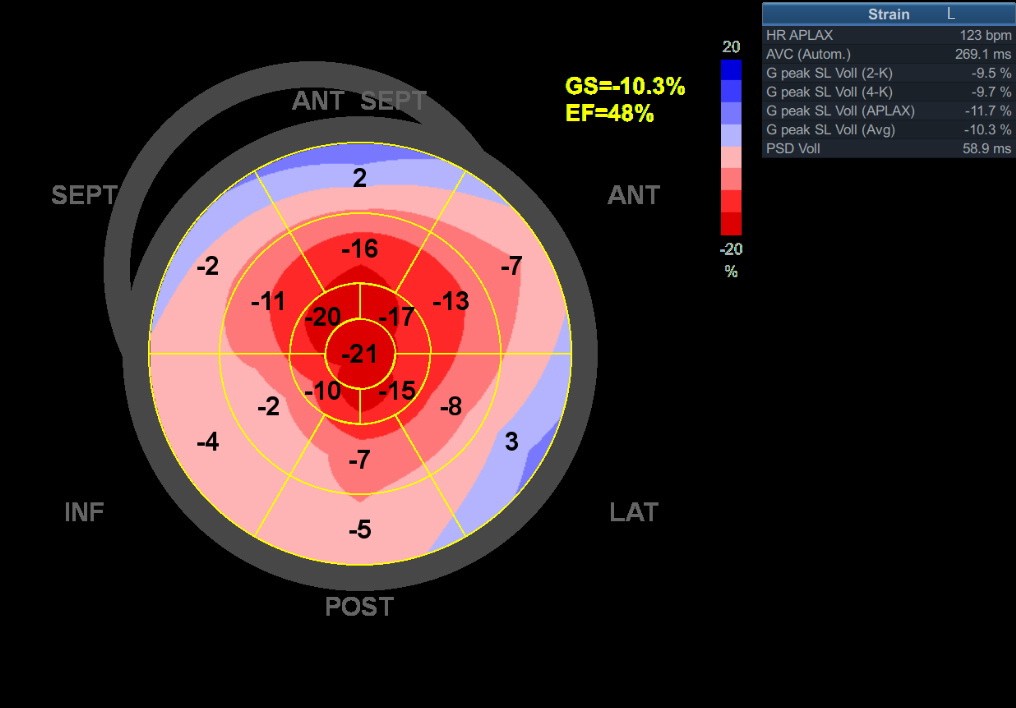
Global strain severely reduced -10,3%
EF mildly reduced
Dispersion mildly prolonged 59msec
Concentric myocardial wall thickening
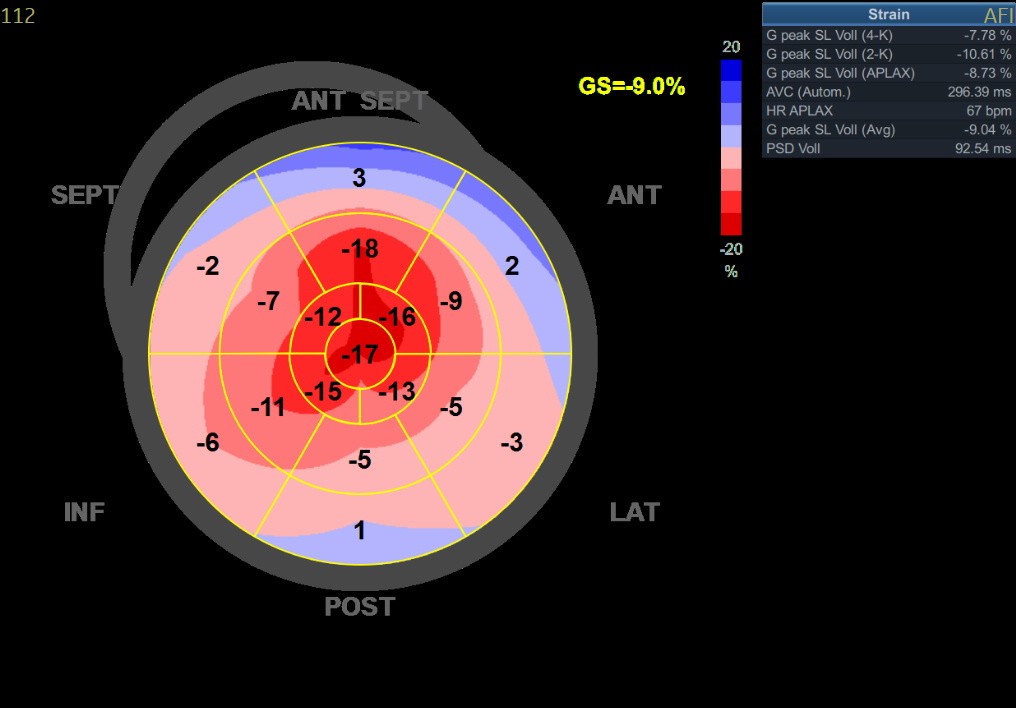
Strain reduction with a basal to apical gradient showing a cherry on top pattern
Amyloidosis & echocardiography
IVS >12mm + additional findings
Increasing LV masse
Mitral TDI <5cm/sec (medial/lateral), DD II (or earlier)
Reduced S’ or a’ (<5cm/sec)
GLS >-15%
Relative apical sparing (cherry on top)
Atrial dilatation (& strain reduction)
Pleural- and/or pericardial effusions
Echoscoring — IVS ≥12mm
RWT >0,6 (3 points)
E/e’ >11 (mean) (1 point)
TAPSE ≤19mm (2 point)
GLS more positive than -13% (1 point)
Systolic longitudinal strain apex to base ratio >2,9
8 points with extracardiac amyloid from a biopsy ➜ diagnostic
Limitations ➜ many measurements
Remember: Know the (strain)patterns for early recognition
Garcia-pavia et al., 2021, European Heart journal
Hypertensive heart disease
Hypertensive heart disease with hypovolemia & SAM
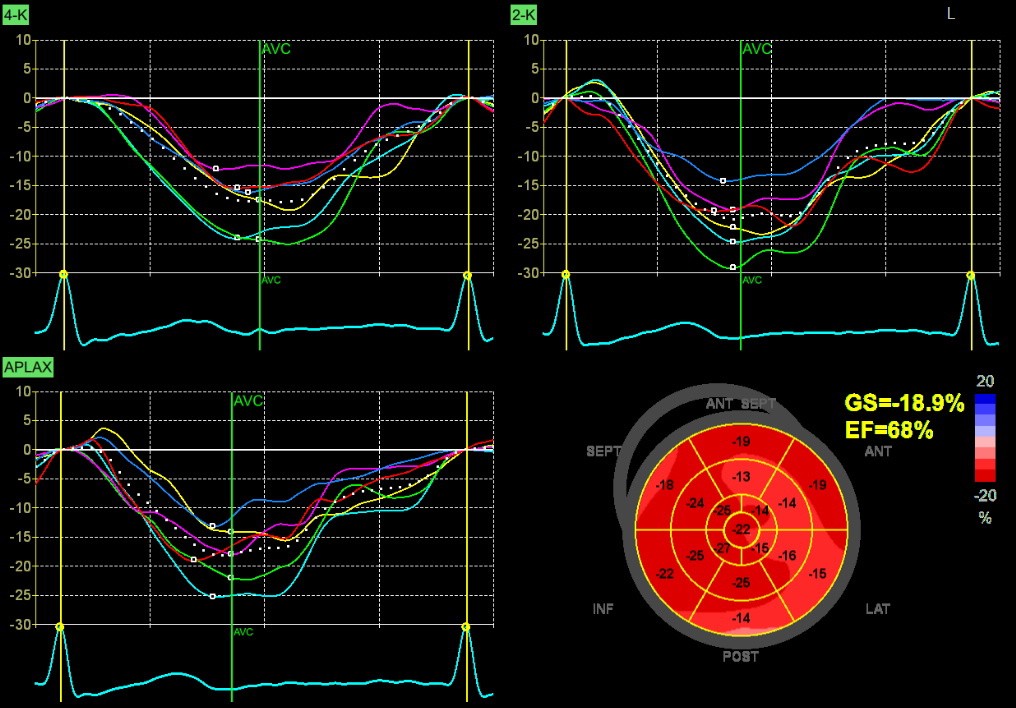
HTN vs. HCMP vs. Amyloidosis
LA Strain as a differentiation for myocardial wall thickening
Storage disease/restrictive CMP with the lowest values
Hypertensive heart disease with an LASr >20%, amyloidosis <20%
In HCMP, a reduction of all 3 LA Strain phases is possible
LA Strain values improve in reversible myosin inhibitors (LASr (baseline 20,5%) 2,8% in 56 weeks, LASct (baseline -8,7%) -1,2%) ➜ reverse remodelling of the LA
Significant improvement of the GLS in HOCMP with Mavacamten (especially in the areas with the most significant reduction)
LASr as a predictor in HCM for ≤6METS (cut-off ≤8% — Limitation 3D LA Strain)