Ischemic heart disease & non-ischemic CMP
If GLS, in ischemic CMP, is more positive than -6,95% and in non-ischemic CMP, there is a drastic risk increase for CV-events
More negative than -6,95% in ischemic CMP, higher risk than non-ischemic (independent of EF) for CV-events
Dispersion >60ms ➜ substrate for arrhythmia in ischemic CMP (ICD?)
Reduction in strain over time = worsening of prognosis
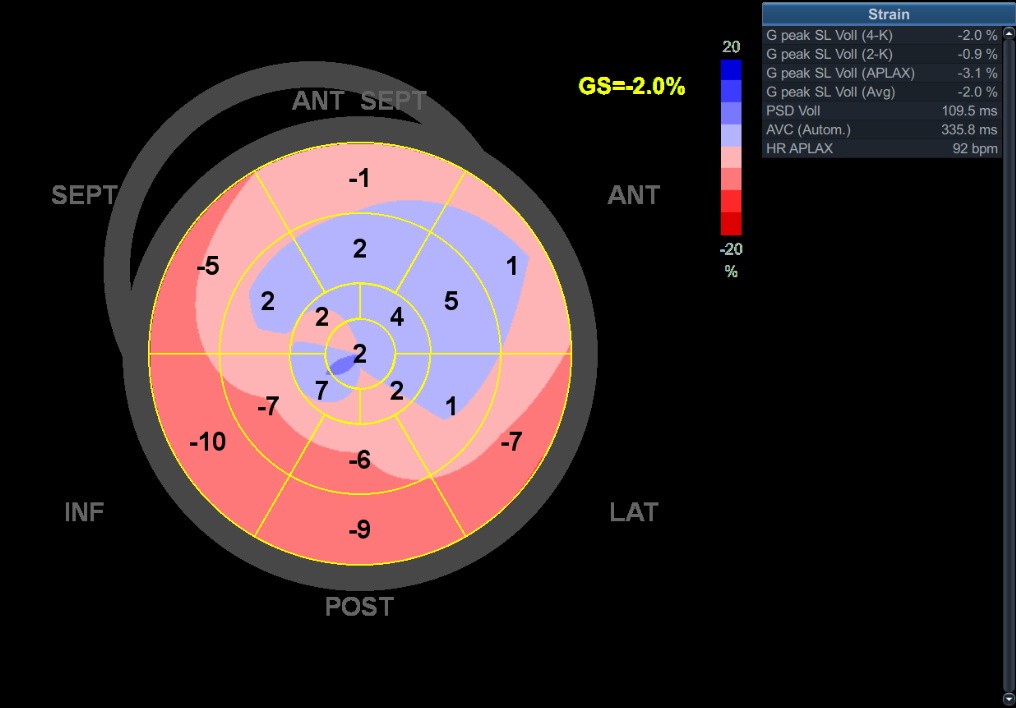
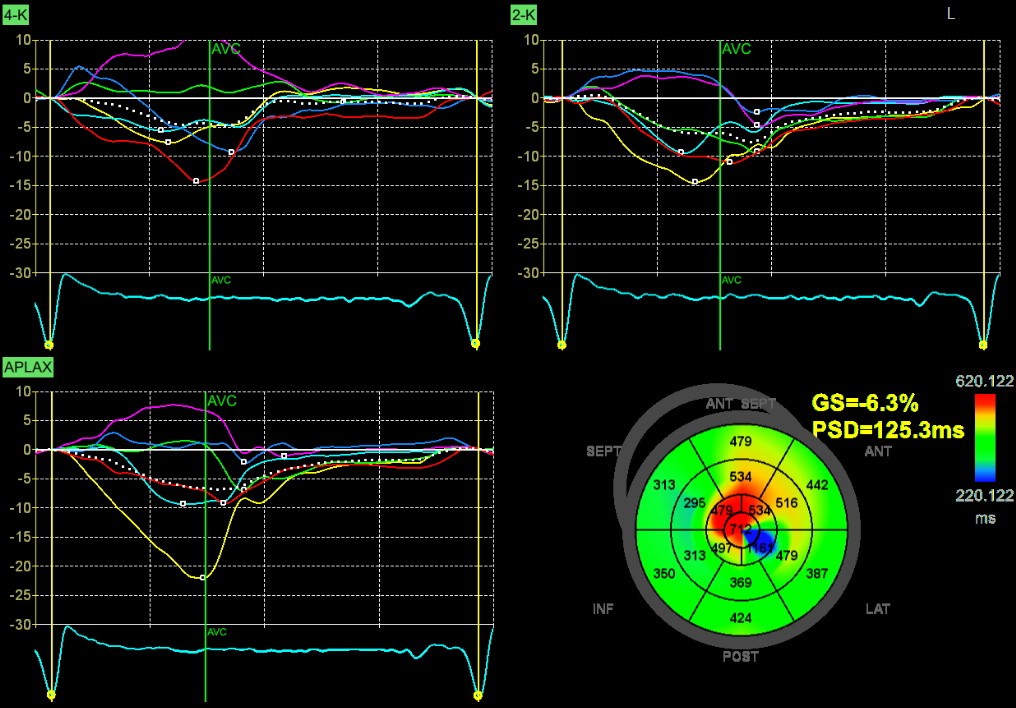
EF 15%, GLS severely reduced,
Dispersion 109ms
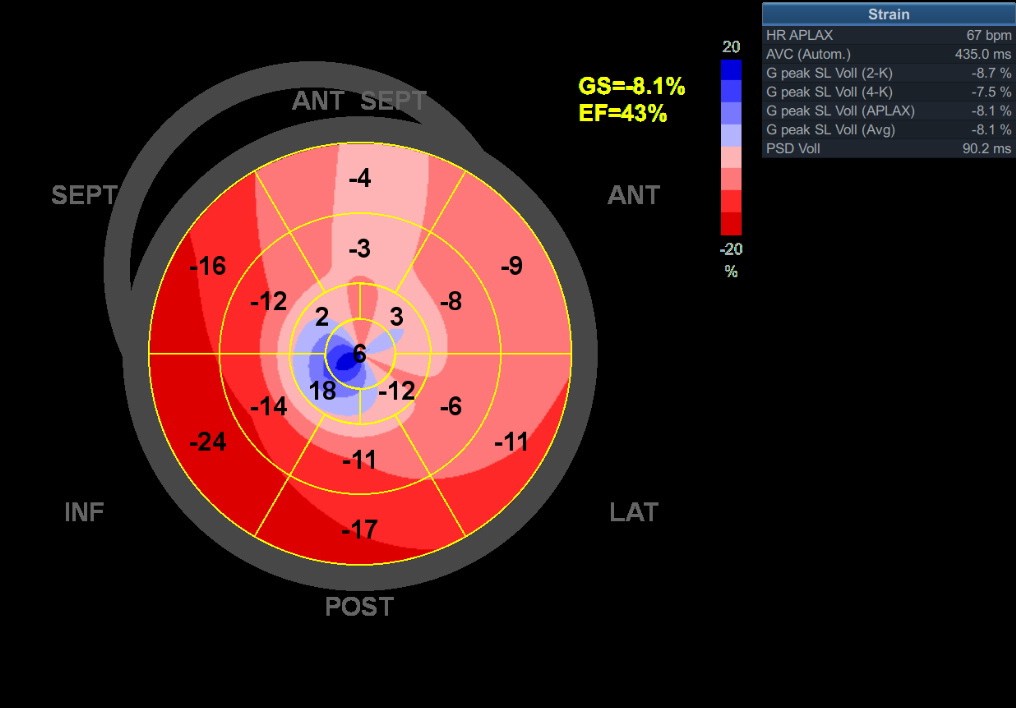
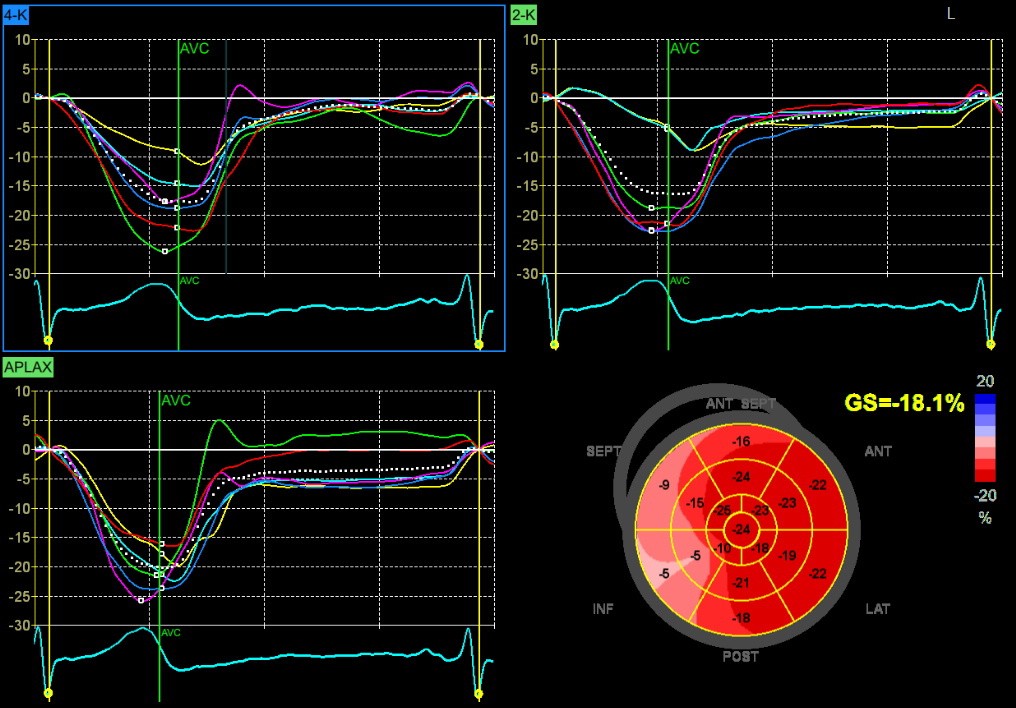
Large anterior infarction with HFimpEF; Dispersion 90ms
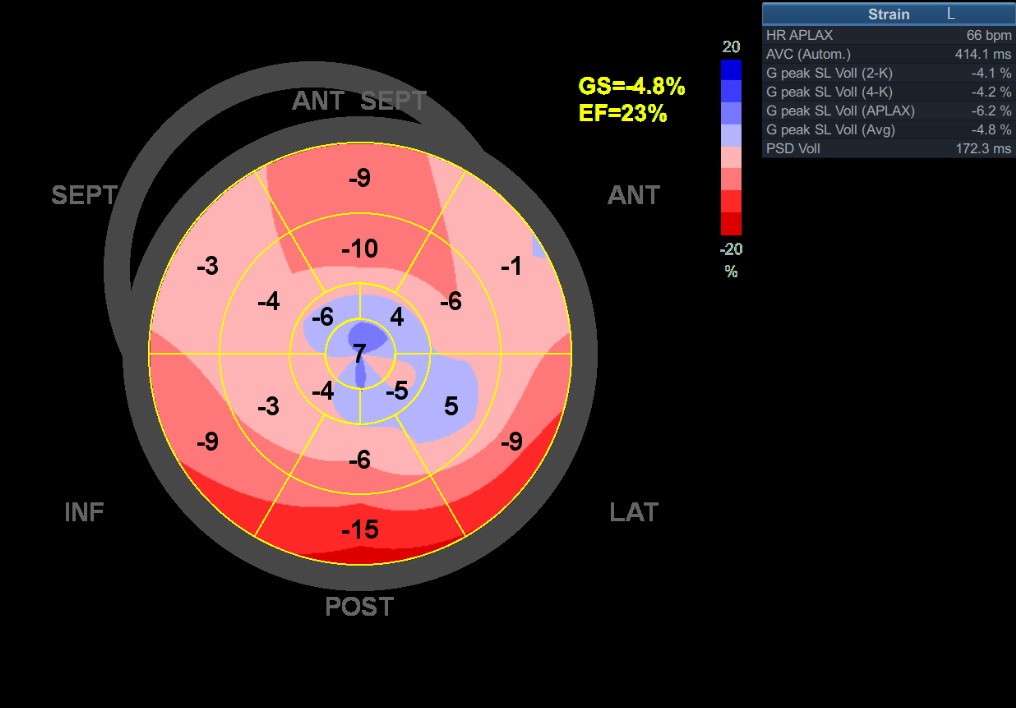
Large anterior infarction with HFrEF; Dispersion 172ms
EF 15%, GLS severely reduced,
Dispersion 109ms
EF 15%, GLS severely reduced, Dispersion 109ms
Large anterior infarction with HFimpEF; Dispersion 90ms
Large anterior infarction with HFrEF; Dispersion 172ms
Motoki H, JACC 2012; Melichova, international Journal of Cardiology 2021
Heart failure & ischemic CMP
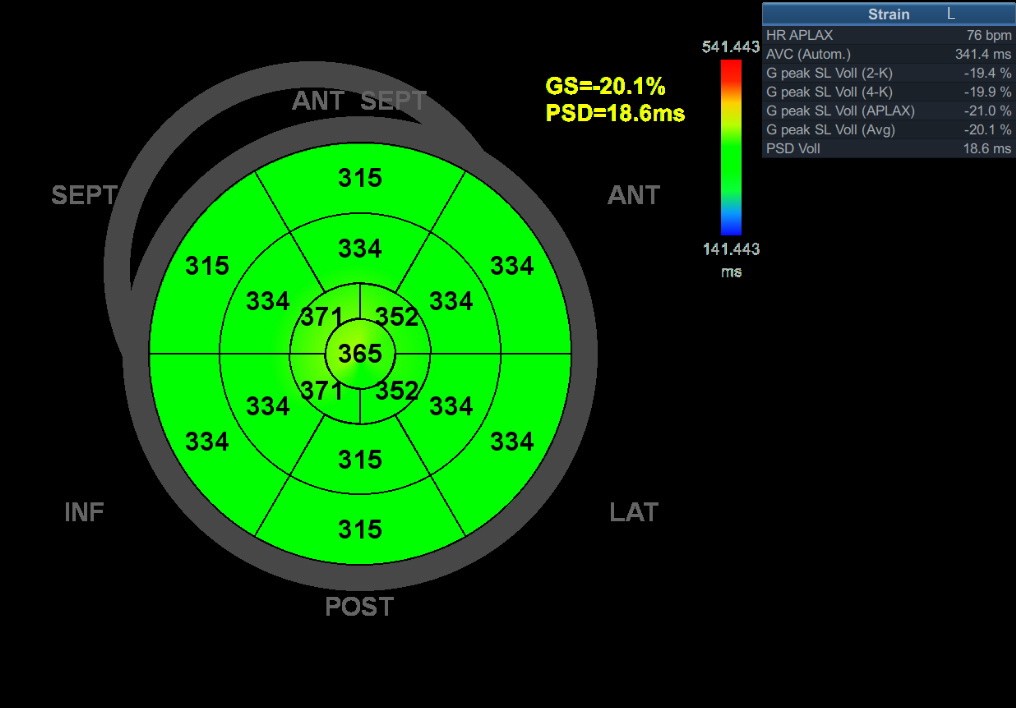
Normal vs pathological
Normal dispersion <60ms
= homogenous contraction of all LV segments
Severely prolonged Dispersion in ischemic CMP
Normal dispersion <60ms
= homogenous contraction of all LV segments
Severely prolonged dispersion in ischemic CMP
Acute coronary syndrome & ischemic CMP
More LV Remodeling after 6 months post-STEMI in a GLS more positive than -15% at the acute setting
Survival in ischemic CMP cut-off <-11,5% better during the acute coronary syndrome
Improvement of strain with heart failure therapy (reverse remodeling)
Early systolic reduction in LV-function in EF >35% & WMA through GLS in patients with risk factors for and with the diagnosis of ischemic CMP as an outcome parameter
Bertini M, 2012 / Joyce E, 2014 / Stanton, 2009
Inferior STEMI with a still normal Strain in the acute Setting/ Dispersion 49ms
Inferior STEMI with a still normal Strain in the acute Setting/ Dispersion 49ms
More PSS, better recovery after CAG (also in PSS during stress test)
Ischemic memory can also be shown via PSS & ESL (cut-offs not clear, transient ischemia for seconds until minutes)
GLS >-12% as severely reduced strain in CAD, -15 to -16% as risk marker, PSI >10% in a borderline Strain as an additional predictor for mortality
Inferior infarct with post systolic shortening
Borderline normal TAPSE, severely reduced FWS
(RV involvement)
Inferior infarct with post-systolic shortening
Borderline normal TAPSE, severely reduced FWS
(RV involvement)
Bertini M, 2012 / Joyce E, 2014 / Stanton, 2009
Severely reduced Strain, systolic lengthening, no PSS, equal transmural scar.
PSS in dyskinesia is often passive; myocardial work is done by other segments
PSS in hypo-akinesia is often a marker for active (ineffective) contraction of the myocardium
In hypokinesia, biphasic contraction with early-to midsystolic contraction & post-systolic contraction; idem possible in akinesia ➜ potential marker for viable myocardium
Overall: in healthy individuals (insignificant), PSS in up to 1/3 of all segments possible (short & little); the same holds true for early systolic lengthening
Overall: more preload ➜ less PSS; more afterload ➜ more PSS
Deformation also due to medications (BB, dobutamine) & also being influenced by DM & HTN
More fibrosis ➜ more PSS & ESL as a marker for viability
Transmural scar ("nothing is happening") ➜ no more deformation, also in normal segments PSS possible
Myocardial work as a new additional parameter for „wasted work“
Scarring and aforementioned systolic lengthening
Scarring and aforementioned systolic lengthening
Skulstad et al., 2002, Basic Science Reports Brainin, Diagnostics 2021