Aortic valve regurgitation
Symptomatic moderate & severe AR show more positive (worse) GLS values compared to asymptomatic
Pre-operatively GLS >-19,5% — worse prognosis
Asymptomatic AR GLS >-19,5% — mortality is increased
Reduced GLS in moderate to severe AR
Reduced GLS in moderate to severe AR
Reduced Strain (>-19,5%) with boderline EF with LV-dilatation in moderate-severe AR
Reduced Strain (>-19,5%) with boderline EF with LV-dilatation in moderate-severe AR
Mitral valve regurgitation
The GLS as a marker for outcome independent of EF
GLS >-21% pre operatively ➜ worse outcome in primary MR (GLS + STS score)
GLS >-20,7% + elevated BNP ➜ worse outcome in primary MR (10a follow-up)
GLS >-21,7% — primary MR with normal EF (>60%) & normal LV-dimensions ➜ worse outcome
GLS >-18,1% pre operatively ➜ LV dysfunction after valve surgery will persist
MitraClip: STS-score + GLS cut-off -14,5% for worse outcome (1a follow-up)
CAVE: for healthy individuals, the GLS would be normal; in MR, a "normal" strain is already significantly pathological (more shear forces in the basal segments)
Secondary MR — LASr significantly reduced in relevant MR (<10%) with worse prognosis
For primary MR, an already reduced GLS with high-normal EF
Regionally, there is a basal to apical gradient, not typical apical sparing, but an early marker for cardiac remodeling
(➜ more wall stress basally)
For primary MR, an already reduced GLS with high-normal EF
Regionally, there is a basal to apical gradient, not typical apical sparing, but an early marker for cardiac remodeling
(➜ more wall stress basally)
Cases — Mitral valve regurgitation
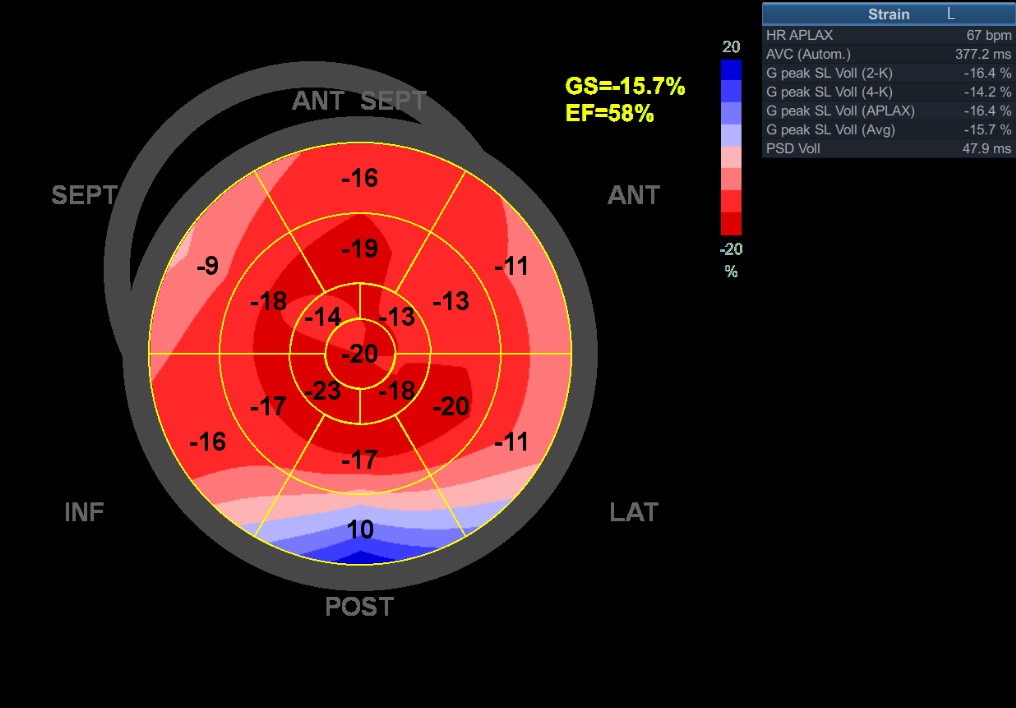
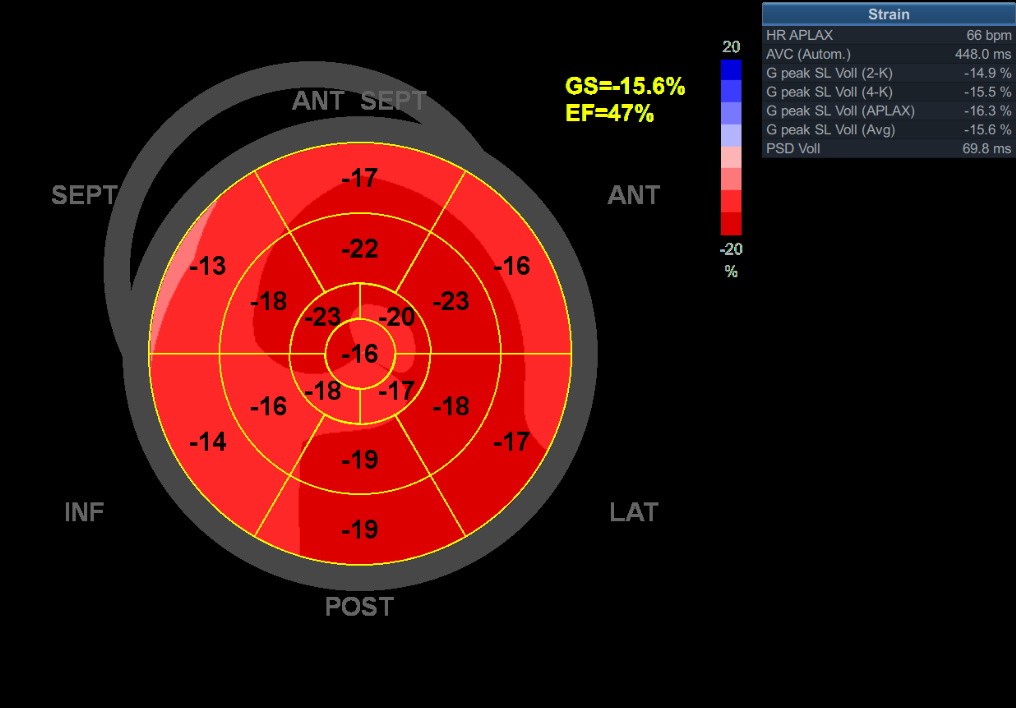
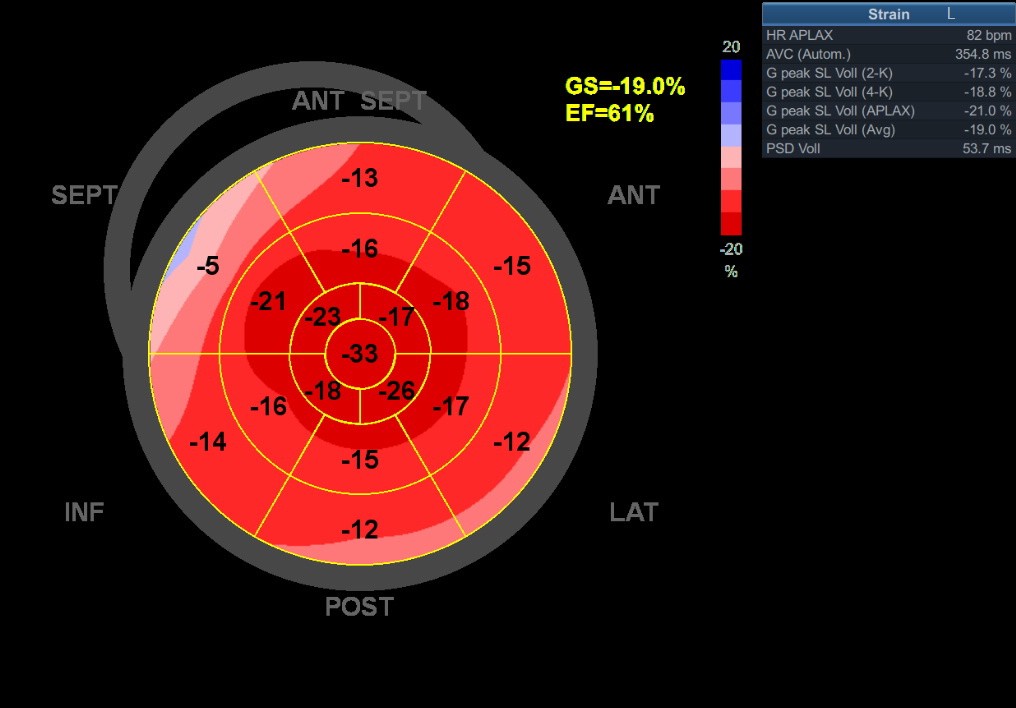
Severe MR (prolaps PMVL), basal reduction of the Strain, high-normal EF
Severe MR (prolaps PMVL), basal reduction of the Strain, high-normal EF
Normal RV Strain, reduced LA Strain, GLS -20,8% borderline
Normal RV Strain, reduced LA Strain, GLS -20,8% borderline
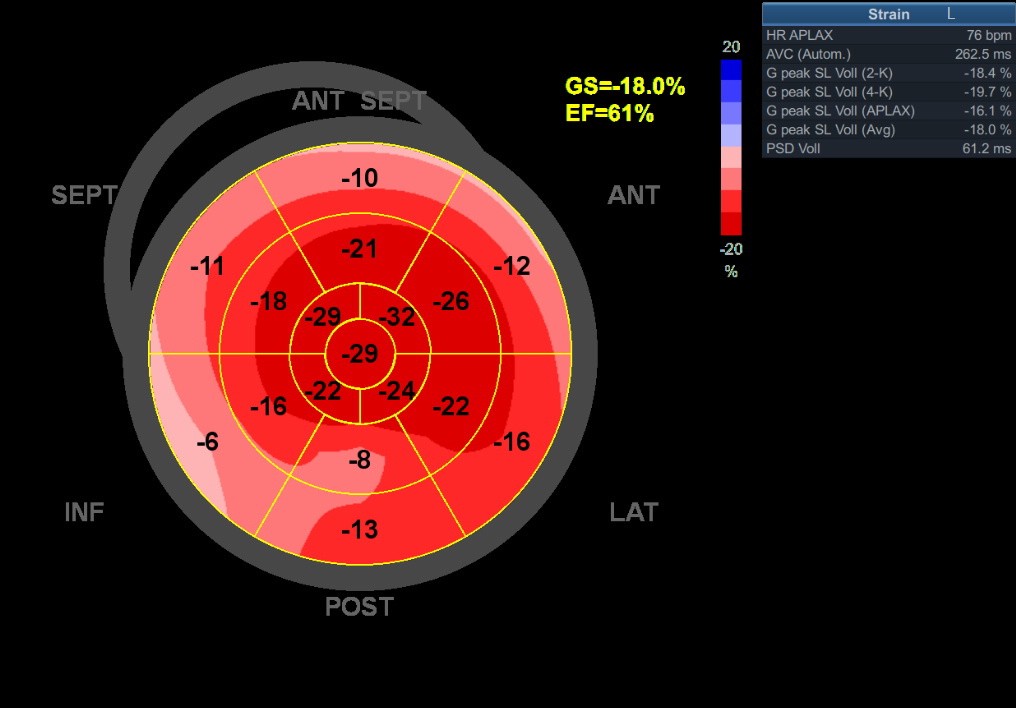
Mitral valve prolapse (MVP) with inferior basal & inferolateral basal regional reduced Strain
In LGE in MRI inferolateral basal significantly reduced strain (-12%), without LGE strain showing normal values but reduced compared to the other segments segments (-18%) as a possible marker for VES & VT
Due to MVP, there is more "wear and tear", PM malpositioning, changes in the basal valvular structures as a potential reason of localised fibrosis (2nd "spike" after AVC with a late peak contraction, per se not PSS)
Normalisation after mitral valve repair
Double-peak Strain can show fibrosis (MRI in LGE) with a regionally reduced Strain anterolateral (red curve)
Double-peak Strain can show fibrosis (MRI in LGE) with a regionally reduced Strain anterolateral (red curve)