
Chapter 6. Valvular heart disease & Strain — Volume vs pressure problem

Chapter 6. Valvular heart disease & Strain — Volume vs pressure problem

Aortic valve stenosis

  • Initially, partly fibrotic changes (GLS -21 to -15%) in a compensated state, in the long run diffuse  replacement“ fibrosis (cut-off -16,2%) — LV & LA stiffness & diastolic dysfunction increase

  • EF is not a primary benchmark for outcome

  • EF (acute) & GLS (acute and gradually) improve — GLS as a good follow-up parameter (reverse remodeling) post-operatively

LASr 14%, GLS -12% in critical AS with elevated filling pressures

LASr 14%, GLS -12% in critical AS with elevated filling pressures

TAVR

Strain as a marker for PM-dependency

  • Apical to basal Strain ratio >1,9 as a marker for PM dependency

  • Calculation in the 17-segment model: GLS Apex (5 segments) / GLS basis (6 segments)

3D TTE subcostal TAVI

3D TTE subcostal TAVI

  • Examples: pre-TAVR: 73/63=1,159

  • Post TAVR without PM dependency likely: 81/89 =0,91

  • Significant improvement of the GLS in critical AS post TAVR
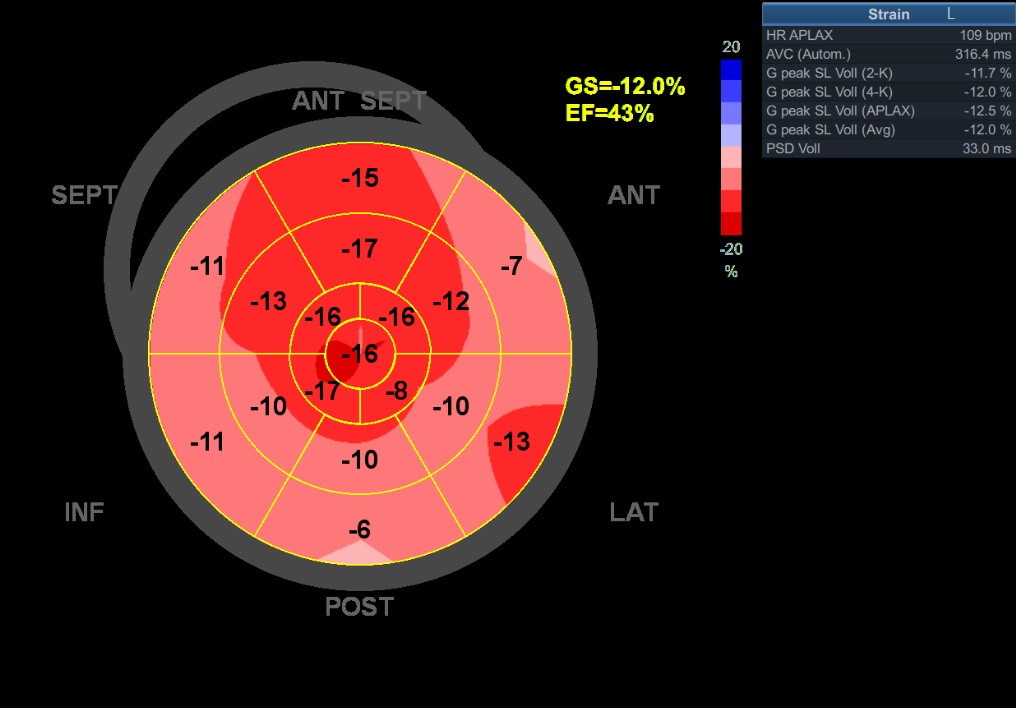
Pre-TAVI GLS

Post-TAVI improvement

Pre-TAVR GLS

Post-TAVR improvement

The contents of the website, including the videos, were created without influence from third parties.

The contents of the website, including the videos, were created without influence from third parties.

The Strain Book

Represented by Dr. Martin Altersberger

Contact: heart.lungs.ultrasound@gmail.com

The Strain Book

Represented by Dr. Martin Altersberger

Contact: heart.lungs.ultrasound@gmail.com

© 2026 The Strain Book by Dr. Martin Altersberger. All rights reserved.

© 2026 The Strain Book by Dr. Martin Altersberger. All rights reserved.

© 2026 The Strain Book by Dr. Martin Altersberger. All rights reserved.